

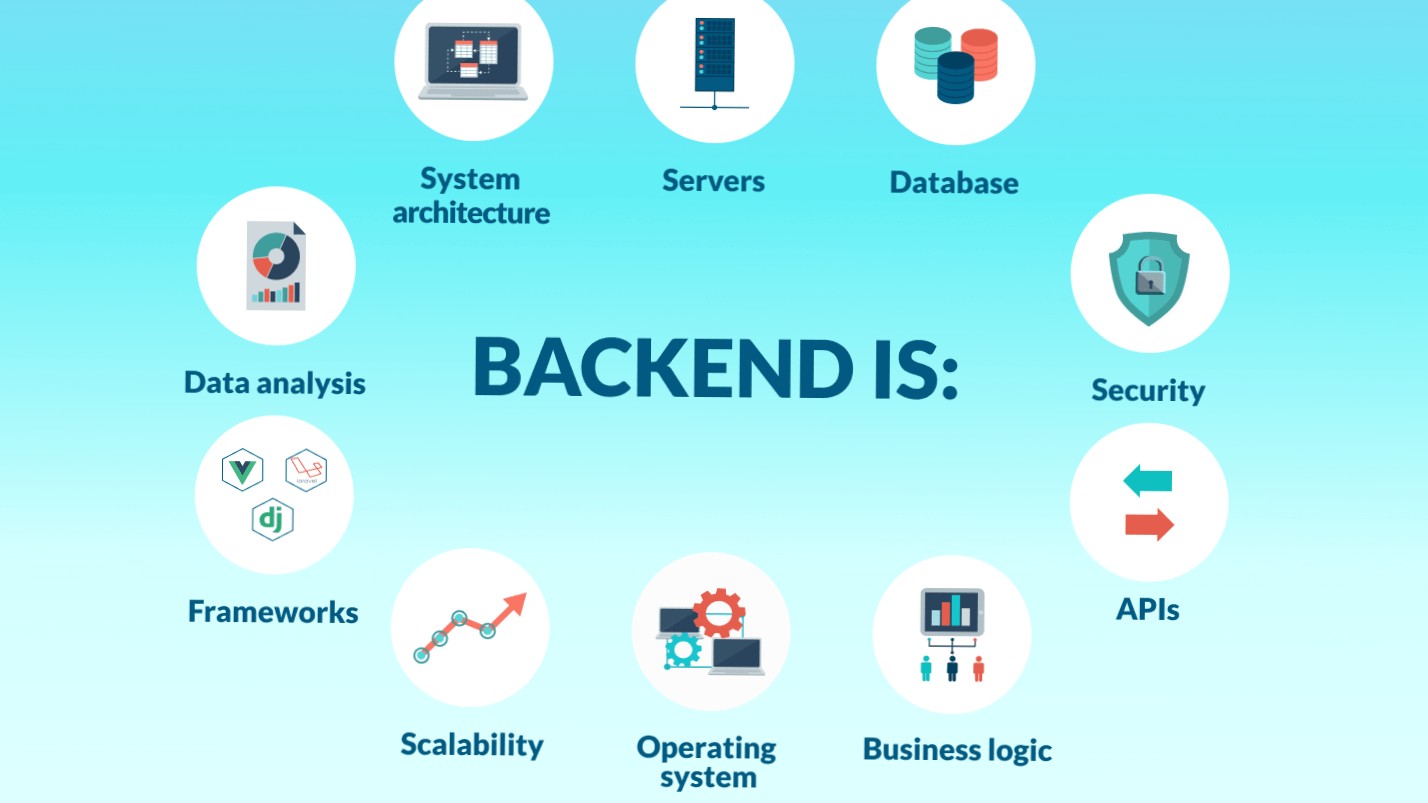
The backend is the server-side part of an application. It works behind the scenes and is responsible for processing data, handling business logic, managing databases, and ensuring security. Users do not see the backend directly, but it powers everything in a website or app.
Main Components of Backend:
1. System Architecture
It defines how different parts of the application are structured and connected (e.g., client-server architecture, microservices). It ensures smooth communication between frontend, server, and database.
2. Servers
Servers handle client requests and send responses. They store, process, and manage application data.
3. Database
Databases store and organize data such as user information, products, orders, etc. Examples include MySQL, MongoDB, and PostgreSQL.
4. Security
Backend ensures data protection through authentication, authorization, encryption, and secure APIs.
5. APIs (Application Programming Interfaces)
APIs allow communication between frontend and backend. They send and receive data using HTTP methods like GET, POST, PUT, and DELETE.
6. Business Logic
Business logic contains the rules and operations of the application. For example, calculating discounts, validating user login, or processing payments.
7. Operating System
The backend runs on an operating system (Linux, Windows, etc.) that manages server resources and processes.
8. Scalability
Scalability ensures that the application can handle increased users and traffic without performance issues.
9. Frameworks
Backend frameworks help developers build applications efficiently. Examples include Django, Spring Boot, Express.js, etc.
10. Data Analysis
Backend systems often analyze stored data to generate reports, insights, and analytics.
Conclusion
Backend is the backbone of any web or mobile application. It manages data, security, performance, and communication between different systems, ensuring the application works smoothly and efficiently.
Main Components of Backend:
1. System Architecture
It defines how different parts of the application are structured and connected (e.g., client-server architecture, microservices). It ensures smooth communication between frontend, server, and database.
2. Servers
Servers handle client requests and send responses. They store, process, and manage application data.
3. Database
Databases store and organize data such as user information, products, orders, etc. Examples include MySQL, MongoDB, and PostgreSQL.
4. Security
Backend ensures data protection through authentication, authorization, encryption, and secure APIs.
5. APIs (Application Programming Interfaces)
APIs allow communication between frontend and backend. They send and receive data using HTTP methods like GET, POST, PUT, and DELETE.
6. Business Logic
Business logic contains the rules and operations of the application. For example, calculating discounts, validating user login, or processing payments.
7. Operating System
The backend runs on an operating system (Linux, Windows, etc.) that manages server resources and processes.
8. Scalability
Scalability ensures that the application can handle increased users and traffic without performance issues.
9. Frameworks
Backend frameworks help developers build applications efficiently. Examples include Django, Spring Boot, Express.js, etc.
10. Data Analysis
Backend systems often analyze stored data to generate reports, insights, and analytics.
Conclusion
Backend is the backbone of any web or mobile application. It manages data, security, performance, and communication between different systems, ensuring the application works smoothly and efficiently.